


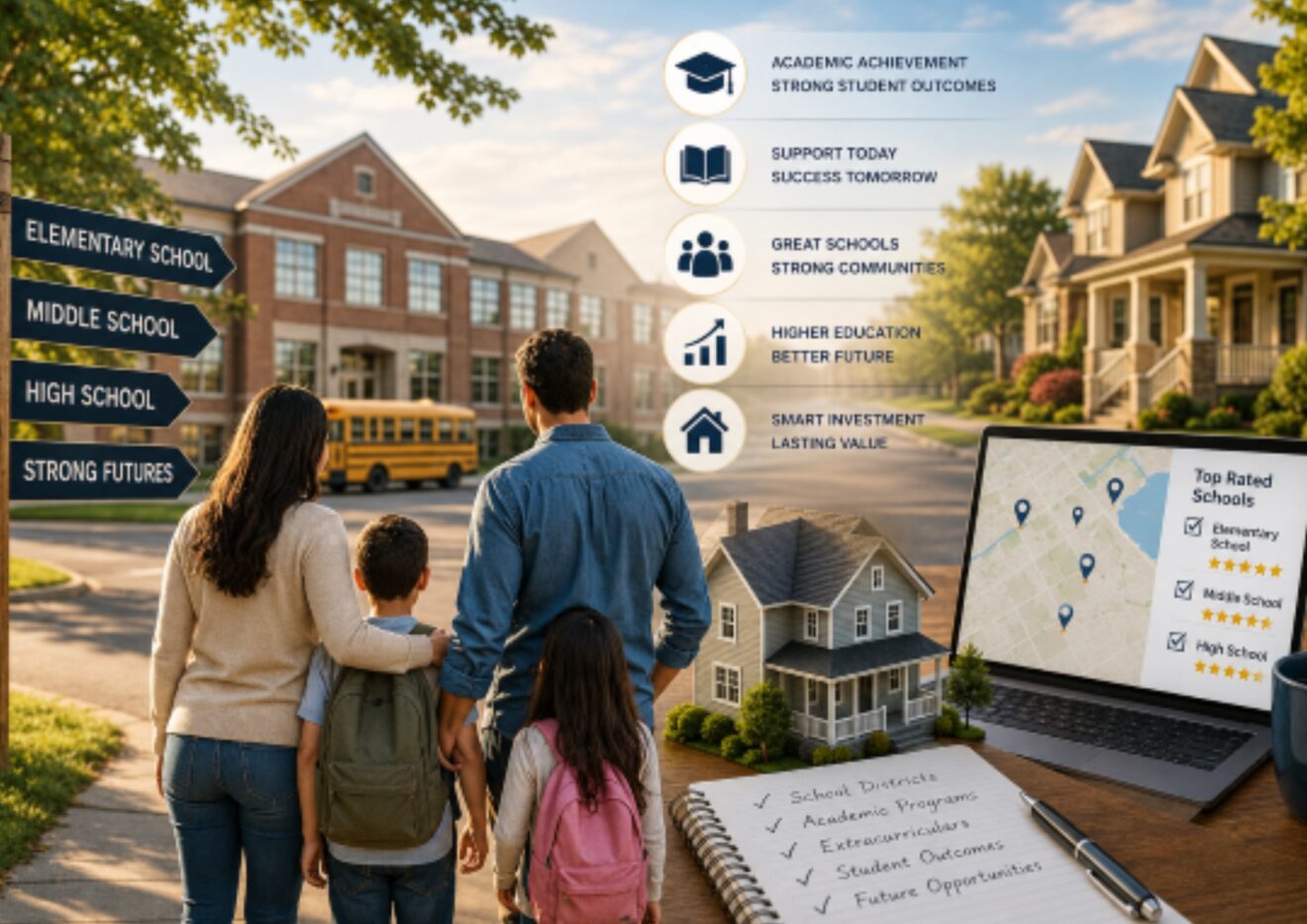

When families begin searching for a home, conversations about schools often start with one question: “How good is the elementary school?” It’s understandable. Parents of young children naturally focus on the immediate future. Yet as communities across the Greater Toronto Area continue to grow, a broader trend is emerging. More families are recognizing that school demand does not end at elementary school. In fact, demand often becomes even stronger as students move into middle school grades, secondary education, and eventually high school. The reality is that education is a long journey, and parents increasingly understand that the choices made today can influence student outcomes for years to come. Understanding why school demand can extend beyond elementary grades helps explain not only educational trends but also why certain communities remain highly desirable among homebuyers.
Looking Beyond Elementary School: The Long-Term View of Education
For decades, conversations about school quality often focused on elementary school performance. Families would compare test scores, review local school board rankings, and look for strong academic foundations for younger students. While these factors remain important, many parents are now taking a longer-term perspective.
Today’s families recognize that educational success involves much more than a strong start. As children move through elementary grades, middle school, and eventually high school, they encounter increasingly complex academic expectations and social challenges. A school system that supports students throughout this journey often becomes more attractive than one that only excels in the early years.
This shift is supported by growing amounts of education research. Studies consistently show that long-term student success depends on continuous support rather than isolated achievements during the early years. Parents increasingly seek communities where educational opportunities remain strong across all grade levels.
The demand for educational options also extends beyond traditional academic pathways. Modern families value schools that offer diverse educational experiences, recognizing that different students learn in different ways. Diverse educational paths acknowledge different learning methods and create opportunities for students with varying strengths and interests.
As a result, many families evaluate entire school districts rather than focusing solely on one elementary school. They want confidence that their children will continue receiving support, encouragement, and opportunities as they progress through each stage of their education.
The Growing Focus on Middle School and Secondary Education
The transition from primary school to middle school grades is one of the most important periods in a student’s academic journey. During these years, children experience significant cognitive, emotional, and social development.
Research on improving middle school outcomes has become increasingly important because these years often influence future success in secondary school. Many education researchers conducted dozens of studies examining how middle school experiences affect long-term academic performance and social development.
Parents are paying attention. They recognize that strong middle school outcomes often contribute to higher levels of student achievement, better preparation for high school, and improved opportunities after graduation.
Older students face increasingly complex academic expectations. Coursework becomes more rigorous, social dynamics evolve, and students begin thinking about future career paths. Schools that provide strong support systems during these years become highly valued.
Many communities now promote specialized programs designed specifically for middle and secondary education. Vocational and specialized programs help bridge the gap between school and professional work, giving students practical experiences while still completing academic requirements.
High school options have also expanded significantly. Many schools now offer pathways that prepare students for university, college, apprenticeships, and skilled trades. Families increasingly seek educational environments that provide flexibility and choice.
Research shows that expanded educational options often correlate with higher future income. Parents understand that educational opportunities offered during adolescence can significantly influence future career outcomes and overall well-being.
Importantly, today’s families are not solely focused on grades. Many parents value long-term happiness and well-being over academic achievement alone. Schools that support emotional skills, social development, leadership opportunities, and experiential learning often generate strong demand.
Students today require diverse, experiential, and socio-emotional learning environments. Schools that successfully provide these opportunities often become key drivers of community demand and homebuyer interest.
Understanding Grade Retention and Long-Term Student Outcomes
One of the most discussed topics in modern education circles is grade retention. Questions about whether retaining kids helps or harms learning continue to influence education policy and school practices across North America.
Historically, grade retention bad became a common discussion point among educators because many studies found concerning long-term effects. While some students may show short-term academic improvement after repeating a year, the long-term picture is often more complicated.
According to findings frequently cited in the Education Policy Analysis Archives, and supported by broader education statistics, approximately 15% of elementary students in the United States experience some form of retention during their educational journey. Among low-income children in grades one through three, approximately 9.7% were retained. Research also found that 3.2% of Black students were retained in 2015 compared to 1.8% of White students.
Many students identified for retention share common characteristics. Students with low academic readiness are most likely to be retained, and retention is more common among minority and low-income students.
Several forms of retention exist. Some districts use test based retention policies, while others rely on discretionary grade retention whenever teachers, parents, and administrators use judgment rather than automatic rules. Some jurisdictions implement theoretically mandatory retention policies, while others allow greater flexibility.
The debate often centers on whether social promotion or retention produces better outcomes. While some educators believe repeating a same grade level can help struggling learners master missing skills before moving to the next grade, research frequently points toward alternative solutions.
Many studies suggest that providing appropriate instructional supports may be more effective than simply placing a student in the same grade again. Interventions such as tutoring, summer learning, academic coaching, and targeted support programs often benefit students without requiring retention.
Research conducted by organizations including the National Center for education studies has found that retained students frequently face significant challenges later in life. Studies indicate that students retained are substantially more likely to leave school before graduation, part of a broader pattern of poorer academic outcomes linked to retention. Some research suggests retained students are up to 11 times more likely to drop out before they graduate high school.
Retention has also been associated with lower self-esteem, negative attitudes toward school, and difficulties maintaining relationships with same age peers. Many retained students experience challenges within peer groups, which can affect social adjustment and emotional development.
Researchers have also found links between retention and broader life outcomes. Studies examining economic research and education trends have identified correlations between retention, fewer employment opportunities, increased behavioral concerns, higher arrest rates, and elevated substance abuse risks later in life.
This does not mean that every retained student experiences these outcomes. However, it highlights the importance of providing meaningful support before retention becomes necessary. Debates over early grade retention also examine whether added costs are only a fraction of a full extra school year when long-term supports reduce later remediation.
Many school psychologists, teachers, and school psychology professionals advocate for early intervention rather than grade repetition. By identifying at risk students early, schools can often provide support that improves student learning while preserving confidence and motivation.
Programs such as summer school, targeted literacy instruction, and individualized learning plans can assist students before they fall significantly behind. In some discussions, retention is framed as part of preparing students for later coursework when paired with strong supports. These approaches focus on improving student outcomes rather than relying solely on retention.
The conversation around retention also helps explain why demand extends beyond elementary school. Parents increasingly seek school systems that provide long-term support structures, intervention programs, and personalized educational pathways throughout a child’s academic career.
Many successful school systems now emphasize continuous improvement rather than punitive measures. School and district leaders are investing in strategies designed to support learners at every stage, from third grade through fifth grade, middle school, and high school completion.
Extended learning time is one example. Research shows that additional instructional hours can significantly improve outcomes for struggling learners. Some extended school year programs can run more than 200 days annually. In 2005, Massachusetts increased instructional time by approximately 300 hours. KIPP schools provide up to 50% more learning time than traditional schools, while extended school days can add between 150 and 300 minutes of instruction weekly.
Dallas ISD introduced five voluntary intersessions designed for targeted enrichment and academic support. Retention debates also consider possible spillover effects on other students, not just retained students themselves. Research consistently shows that extended learning time improves outcomes for low-achieving students and helps narrow achievement gaps.
These innovations demonstrate why demand continues through secondary education. Families are looking for educational environments that evolve with students’ needs, offering support, flexibility, and preparation for future success.
Practical Tips for Homebuyers Evaluating School Communities
If schools are influencing your home search, consider these practical steps:
- Research the full educational pathway, not just the nearest elementary school.
- Review available middle school and high school programs.
- Explore vocational, specialized, and experiential learning opportunities.
- Look at graduation rates and high school completion statistics.
- Ask about intervention programs for struggling students.
- Investigate summer school and enrichment opportunities.
- Consider access to extracurricular activities and leadership programs.
- Speak with local parents about their experiences across multiple grade levels.
- Review school district plans for future growth and development.
- Focus on long-term student outcomes rather than short-term rankings alone.
★ Want to learn more about how schools influence home values and community demand? Have a look at these posts:
What Buyers Overlook When Moving Into School-Focused Communities in the GTA
Why Homes Near Top-Rated Schools Sell Faster — and for More
The Best Schools in the GTA: A Homebuyer’s Guide
Conclusion
The demand for quality schools does not stop after elementary school. Families increasingly understand that educational success is shaped by experiences that extend through middle school, secondary education, and beyond. From specialized learning pathways and extended instructional time to intervention programs and student support systems, modern school districts are being evaluated on their ability to prepare students for long-term success. As parents prioritize student outcomes, emotional well-being, and future opportunities, communities with strong educational options across all grade levels continue to attract attention from homebuyers. If you’re considering a move and want to understand how schools can influence both your family’s future and your home’s value, Bahia Realty Group Inc. is here to help.
Ready to find a home in a community with strong educational opportunities?
📞 416-498-3444
📧 jas@thebahiateam.com
🌐 www.bahiarealtygroupinc.com