


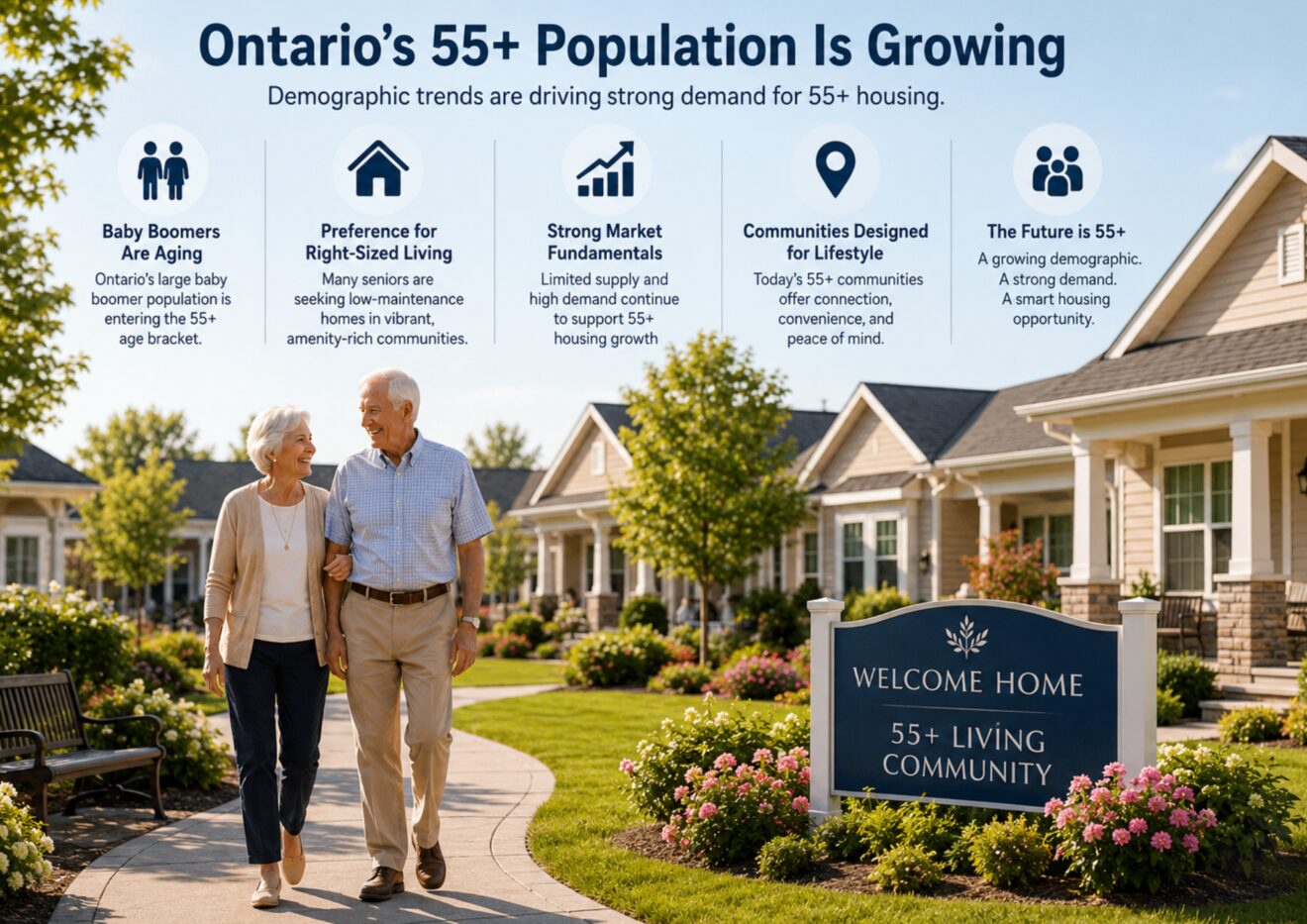

Ontario is getting older, and that shift is directly increasing demand for 55+ housing in Ontario as more seniors and aging baby boomers look for homes that are easier to maintain, more accessible, and built to support independent living and social connection. This article is for homeowners, buyers, families, investors, and developers interested in understanding how Ontario’s aging population is shaping the demand for 55+ housing. Understanding these trends is crucial for making informed real estate decisions and planning for the future.
The traditional idea of staying in the family house forever is no longer the only option. Many older adults are looking for homes that require less maintenance, offer greater accessibility, and provide opportunities for social connection without giving up their independence.
55+ housing refers to homes and communities designed for adults aged 55 and older, often featuring accessibility features (such as step-free entry, wider doorways, and accessible bathrooms) that are essential for aging in place. These residential options typically offer low-maintenance living and community amenities to support independent living as Ontario’s senior population rises.
At the same time, baby boomers are moving into their retirement years in enormous numbers, and the same pattern is playing out nationally: Statistics Canada projects that seniors aged 65 and older will make up 23% to 25% of Canada’s total population by 2036. Ontario’s latest population projections show that residents aged 65 and older could increase from roughly 3.1 million in 2025 to 4.6 million by 2051, while adults aged 65 to 84 are also expected to account for about 20% of Canada’s population by 2041. These demographic trends are creating a growing conversation around seniors housing, active-adult developments, retirement communities, and other housing options designed for later stages of life. For homeowners, buyers, families, investors, and developers, that makes this a practical real-estate issue as much as a demographic one. Understanding how demographic trends are increasing demand for 55 housing in Ontario means looking at Ontario’s aging population, the fast-growing 75+ group, changing senior preferences, housing supply pressures, evolving technology and services in senior living, and the role of location and community in shaping the province’s housing market next.
1. Ontario Is Getting Older
The numbers tell a compelling story. Canada’s senior population grew by 21.7% from 2006 to 2016.
Ontario’s aging population isn’t a short-term trend. It’s a long-term demographic shift that will influence housing for decades.
According to the Ontario Ministry of Finance, approximately 18.9% of Ontario’s population was projected to be 65 or older in 2025. By 2051, that proportion is expected to reach about 22.7%, representing approximately 4.6 million people, while nationally seniors are expected to make up 23% to 25% of Canada’s total population by 2036.
What is 55+ Housing?
55+ housing refers to residential options specifically designed for adults aged 55 and older, often featuring accessibility, low-maintenance living, and community amenities to support independent living as Ontario’s senior population rises. This demographic shift is significant, with 32% of adults aged 55+ in Ontario identified as being in core housing need.
Key Demographic Statistics:
- Ontario residents aged 65+:
- 2025: ~3.1 million
- 2051: ~4.6 million
- Seniors (65+) projected to make up 23%–25% of Canada’s population by 2036
- 32% of adults aged 55+ are in core housing need in Ontario
That creates significant demographic momentum.
As the senior population expands, so does the number of households thinking about downsizing, accessibility, maintenance, healthcare access, and where they want to spend their retirement years.
For Ontario real estate, this means the conversation isn’t simply about building more housing. It’s also about creating the right housing for a changing population.
2. Baby Boomers Are Reshaping Housing Demand
The size of the baby-boom generation makes this transition particularly important.
Ontario’s Ministry of Finance expects rapid growth in the senior population through 2031 as the remaining baby boomers reach 65, with the leading edge of the cohort also moving into older age brackets.
But today’s retirees don’t necessarily want the same lifestyle as prior generations.
Many have spent decades living independently, travelling, working, entertaining friends, and enjoying active lifestyles. When they consider moving, they may not be looking for traditional assisted living facilities or housing centered around basic care.
What is Independent Living?
Independent living refers to housing arrangements designed for older adults who are able to live on their own, with minimal or no assistance, but who may benefit from amenities, social opportunities, and accessibility features that support their autonomy and quality of life.
Instead, many want to live independently for as long as possible.
That creates opportunities for low-maintenance bungalows, condos, active-adult developments, and senior living communities offering a combination of private living space and shared amenities.
The change in consumer preferences is important. In 2016, 13% of seniors were aged 85 and older. Retirement housing increasingly needs to support independence rather than simply respond to declining health.
3. The Growth of the 75+ Population Matters Even More
The most significant change may be happening within the older senior population.
Demographic Statistics:
- Ontario residents aged 75+:
- 2025: ~1.4 million
- 2051: >2.7 million (nearly double)
- Population aged 90+ is projected to more than triple
That’s important because housing needs often change as people move through their seventies, eighties, and nineties.
A healthy 60-year-old may prioritize golf, travel, fitness, and social activities. Twenty years later, that same person may place greater importance on accessibility, nearby health services, transportation, and additional support services.
Longer life expectancy can also mean people spend considerably more time in retirement than previous generations.
That creates demand for communities capable of adapting with their residents, allowing residents to remain in the same setting as care needs change.
Some people may need only independent living. Others may eventually require more assistance, home-care services, memory care, or support for chronic conditions and more complex care. In 2021, 6% of older adults lived in collective dwellings, underscoring how advanced age can increase demand for more supportive housing options.
This is why future housing can’t be designed around age alone. It needs to consider how people’s needs can evolve over decades.
4. What Today’s Older Adults Actually Want
Variety of Preferences
One of the biggest mistakes is assuming everyone over 55 wants the same thing.
They don’t.
Some people want to sell a large suburban home and move into a smaller condo. Others want a bungalow with a garage and backyard. Some want an active adult community with walking trails, fitness facilities, pools, clubhouses, or even dog parks.
Others simply want less maintenance.
The common theme is choice.
The federal government’s guidance on seniors housing reflects this range: people may remain in their existing home with assistance, live with family or friends, move into a retirement community, or choose a retirement residence offering meals and care. Costs generally rise as the amount of service and care increases.
Importance of Accessibility
What are Accessibility Features?
Accessibility features are design elements that make homes safer and easier to use for people with mobility or health challenges. These include step-free entry, wider doorways, accessible bathrooms, single-level living, elevators, and thoughtful layouts. Accessibility features are essential for aging-in-place housing and are increasingly sought after by older adults.
Single-level living, wider doorways, fewer stairs, accessible bathrooms, elevators, and thoughtful layouts can help older Canadians remain independent longer.
Location and Community
Location matters too.
Easy access to grocery stores, medical facilities, public transportation, recreation, and family can make everyday life simpler. For many people, staying connected to their existing neighborhood, children, grandchildren, and friends is just as important as the home itself.
Social Connection
And then there’s community.
Housing isn’t only about shelter. Mental well being, friendships, activities, and a sense of belonging matter, especially as people leave the workplace and their social routines begin to change.
That’s why many communities are putting greater emphasis on shared spaces, activities, fitness, lifelong learning, and opportunities for residents to connect.
The future of senior living in Ontario may therefore be less about creating places where people simply grow older—and more about creating communities where they can continue living independently, socially, and actively for as long as possible.
5. Housing Supply Needs to Keep Up With an Aging Population
Current Supply Challenges
Ontario sits within a senior housing market that is a growing market facing supply pressure, so demand doesn’t automatically mean the province has enough appropriate senior housing units to meet it.
Ontario created 1,825 congregate retirement-home suites in 2024, according to the province’s housing-supply tracker. In 2017, Canada had approximately 258,000 senior housing units. Canada needs approximately 450,000 additional retirement units by 2040. At the same time, the number of Ontarians aged 65 and older is projected to grow from about 3.1 million in 2025 to 4.6 million by 2051.
Those numbers don’t measure the same type of housing, but together they illustrate the scale of the challenge and the pressure behind senior housing demand.
Affordability and Availability
Building appropriate housing takes time. Land prices, approvals, financing, labor shortages, and construction costs can slow new development, while demand continues changing. Occupancy rates in senior housing are projected to reach 90% by 2026, reinforcing how tight availability may become. Average monthly rent for standard spaces in Quebec was $1,788, which also shows how limited supply can affect affordability amid rising costs.
Need for Housing Variety
There is another issue: many seniors aren’t necessarily looking for traditional retirement residences.
Some want smaller freehold homes. Others want condos, bungalows, rental apartments, independent living communities, or developments designed specifically around active adults.
That means Ontario doesn’t simply need more housing. It needs more variety.
6. Technology and Services Are Changing Senior Living
The next generation of senior living communities may look very different from those built decades ago.
Today’s older adults are increasingly comfortable with technology, and future communities will likely incorporate more technology integration into everyday living. By 2030, smart home technology is expected to become standard in senior communities.
Smart-home features can make homes safer and easier to manage. Automated lighting, video doorbells, smart thermostats, emergency-alert systems, and other connected devices can help residents maintain independence.
Healthcare is changing too.
Telehealth services and other forms of digital healthcare delivery may allow residents to access certain services without leaving their homes. Technology shouldn’t replace human care, but it can become another tool that supports independence and connection.
As residents age, communities may also need to offer more services.
A person may initially need no assistance at all but later benefit from transportation, housekeeping, meal programs, wellness services, or access to specialized staff.
The communities positioned for long-term success may be those capable of evolving as their residents’ needs change. Over time, these service models may expand significantly as operators partner with healthcare providers or educational institutions to support residents.
7. Location and Social Connection Matter More Than Ever
A beautiful home isn’t enough if everyday life becomes difficult.
That’s why location should remain one of the biggest considerations when evaluating housing options for older adults.
Access to doctors, pharmacies, grocery stores, recreation, and public transit can make it easier for residents to maintain independence.
Proximity to children, grandchildren, and friends matters too.
For many people, moving into a 55+ community isn’t about withdrawing from everyday life. It’s about making everyday life easier.
The social side shouldn’t be underestimated either.
Social connection can become increasingly important after retirement, particularly when people no longer have daily interaction with coworkers.
That’s why many modern communities emphasize clubhouses, walking groups, fitness programs, hobby clubs, events, classes, and even lifelong learning opportunities through nearby local colleges or community organizations.
The goal is to create an environment where residents can build new relationships while maintaining the ones they already have.
8. What These Demographic Trends Mean for Ontario Real Estate
For homeowners, buyers, developers, and investors, the direction is becoming increasingly clear.
Ontario’s aging demographics are changing what people need from residential real estate.
The province projects that the 65+ population will reach approximately 4.6 million by 2051, while the 75+ population is expected to rise from about 1.4 million in 2025 to more than 2.7 million.
That doesn’t mean every older homeowner will move.
Many seniors will choose to remain in their existing homes, particularly when they have strong emotional ties to the property or when moving and carrying costs make downsizing less attractive. But not every household in this age group is secure, and 32% of adults aged 55+ are in core housing need in Ontario.
But even if only a portion decides to move, the sheer size of the growing senior population can create significant demand for different forms of housing.
It can also affect the rest of the housing market.
When older homeowners move from large detached properties into smaller homes or communities, those existing properties return to the market for younger generations and growing families. In 2021, 8.9% of adults over 65 were in core housing need.
In that sense, creating appropriate seniors housing isn’t only about older Canadians. It can potentially improve how efficiently existing housing is used across generations.
For developers and investors, the opportunity is equally interesting.
Future demand may increasingly favor accessible, low-maintenance homes in convenient locations with flexible amenities and opportunities for community engagement.
The winning formula may not be “senior housing” in the traditional sense.
It may simply be better housing designed around how people actually want to live as they get older.
Practical Tips for Anyone Considering 55+ Housing
If you’re thinking about downsizing or moving into a 55+ community, consider these steps:
- Think about the home you’ll need in 10 or 20 years, not only today.
- Look for single-level layouts and practical accessibility features.
- Compare ownership, condo, rental, and retirement-community options.
- Calculate the complete monthly cost, including maintenance and community fees, and compare expected rent growth across rental or retirement-community choices.
- Consider proximity to healthcare, shopping, family, recreation, and public transportation.
- Ask which services are included and which cost extra.
- Spend time in the community before making a decision.
- Speak with current residents when possible.
- Consider whether the community provides enough opportunities for social interaction.
- Review your current home’s equity and how downsizing could affect your long-term finances, and use Canada Mortgage and Housing Corporation data as a broader housing corporation source when researching options.
Related Articles You May Enjoy
If you’re exploring 55+ housing and retirement living in Ontario, these Bahia Realty Group articles may also be helpful:
- The Best 55 and Adult Living Condos in the Greater Toronto Area: A Complete Buyer’s Guide
- What to Look for When Buying Into an Adult-Living Community in Ontario
- The Future of Adult-Living Real Estate in Ontario
Conclusion
Understanding how demographic trends are increasing demand for 55 housing in Ontario starts with recognizing, as noted by Statistics Canada, that this isn’t simply a real estate trend—it’s a major population shift. Ontario is heading toward millions more residents over 65, including rapid growth among people 75 and older. As baby boomers move further into retirement, demand is likely to continue evolving as part of a broader senior housing demand shift toward accessible homes, lower-maintenance lifestyles, stronger social connections, convenient healthcare access, and communities that allow people to live independently for as long as possible. For homeowners considering their next move, the key is to plan before circumstances force the decision. Understanding your housing choices, finances, lifestyle priorities, and future needs today can give you considerably more control over where and how you live tomorrow, even as similar demographic pressures are becoming more visible in many countries.
If you’re considering downsizing or exploring 55+ communities in Ontario, Bahia Realty Group Inc. can help you understand your options, evaluate the value of your current home, and find a property that supports the lifestyle you want for the years ahead.
Bahia Realty Group Inc.
416-498-3444
jas@thebahiateam.com
www.bahiarealtygroupinc.com